
Deep Learning Tutorials
This topic is for readers who want neural networks to be inspectable instead of magical. The route covers matrix calculus, backpropagation, convolution, receptive fields, optimizer geometry, attention, and small CNN projects. Each page tries to connect a formula, a tensor shape, and a runnable implementation so that the reader can debug the computation rather than only memorize model names.
Frameworks make deep learning convenient, but they also hide the failure points that matter in real work: mismatched shapes, unstable learning rates, incorrect labels, leaking validation data, and gradients that do not flow as expected. The pages in this hub keep the examples small enough that the intermediate values can still be reasoned about.
Suggested Path
Start with matrix calculus and the two-layer MLP backpropagation article if you are still building the connection between derivatives and code. Then move to convolution and receptive field math, where padding, stride, channels, and im2col show how image models are assembled from simple operations. After that, the attention and KV-cache material will be easier to read because the tensor bookkeeping is already familiar.
For every article, change one parameter and rerun the example. A different learning rate, padding value, initialization seed, or hidden width can reveal why the original configuration worked. That habit is more valuable than copying the final code unchanged.
What This Hub Does Not Claim
These tutorials are educational, not production training recipes. They do not guarantee state-of-the-art accuracy, large-scale efficiency, or suitability for sensitive deployments. The purpose is to build a reliable mental model of the computation so that larger frameworks and papers become easier to evaluate later.
Debugging Evidence
A deep learning article is more useful when it shows what can be inspected. For a backpropagation example, that may be a forward value, loss, local derivative, and gradient update. For a convolution example, it may be the input shape, kernel shape, padding, stride, output shape, and receptive field. For attention, it may be token positions, query/key/value shapes, scores, softmax weights, and cached state.
Those intermediate values matter because most mistakes are not visible in the final loss alone. A model can train slowly because the learning rate is wrong, the target is shifted, the shape is transposed, or the validation split leaks information. The route encourages readers to check the computation step by step before treating the model as a black box.
From Small Models to Larger Systems
The small examples on this site are stepping stones. They do not replace modern frameworks, but they make framework behavior easier to question. Once the reader understands a two-layer MLP or a tiny CNN, larger systems can be evaluated with better questions: which tensor is being normalized, which parameters are being updated, what is cached, what is frozen, and what evidence shows the model is generalizing?
This also keeps the page grounded in original learning value. The site is not trying to summarize every popular model name. It focuses on computations that a reader can trace, modify, and compare with code. That is the foundation for reading papers, using libraries responsibly, and debugging larger training workflows later.
Computation Evidence Matrix
| Topic | Core question | Intermediate values to inspect |
|---|---|---|
| Backpropagation | Does the gradient flow through the intended path? | Forward output, loss, local derivative, weight gradient, and update size. |
| Convolution and receptive field | Do output shape and receptive field match the derivation? | Input shape, kernel, padding, stride, output shape, and covered region. |
| Optimizer behavior | Are parameter updates controlled by a reasonable learning rate? | Gradient norm, step size, loss curve, oscillation range, and stopping rule. |
| Attention | Which tokens are compared, and is cached state consistent? | Q/K/V shapes, scores, softmax weights, mask, and KV-cache state. |
Topic hub
Deep Learning Math and CNN Tutorials
A focused learning hub for neural network basics, matrix calculus, backpropagation, optimizers, convolution, attention, and CIFAR-10 Tiny CNN.
Built for readers searching for deep learning math, backpropagation derivations, convolution formulas, attention calculation, CIFAR-10 CNN tutorials, and visual experiments.
Editorial notes
Why these articles belong in one route
This hub is not a glossary of deep learning terms. Each concept is tied to a checkable computation: what tensors the forward pass creates, how the loss sends error signals back to parameters, and how the optimizer changes the next update.
The route starts with small matrices and hand-calculated gradients, then moves into convolution, attention, and the CIFAR-10 Tiny CNN. Readers can verify that formulas and code output agree before moving to larger framework projects.
The companion assets include runnable scripts, animation, and training output, so review can cross-check formulas, source code, and measured results instead of stopping at a short conceptual summary.
What you will build
You will hand-calculate core formulas, run NumPy experiments, inspect figures and animations, then move into a small CNN image classifier.
Recommended reading order
Start with concepts, then move into runnable projects
Neural Network Basics
Move from perceptrons to activation, forward propagation, backpropagation, and training loops.
Matrix Calculus for Neural Networks
Derive dL/dW for y = Wx + b and verify it with finite differences.
Backpropagation as a Computation Graph
Trace local gradients through ReLU and softmax cross-entropy in a two-layer MLP.
Gradient Descent and Optimizer Geometry
Compare gradient descent, momentum, and Adam on a visible quadratic loss surface.
Convolution and Receptive Field Math
Compute convolution output size, receptive fields, channel mixing, and im2col layout.
Transformer Attention Math
Hand-calculate Q/K/V scores, softmax weights, masks, multi-head structure, and KV cache.
CIFAR-10 Tiny CNN Tutorial in C
Build and train a small convolutional neural network for CIFAR-10 image classification, then read its loss and accuracy output.
Model Training and Evaluation
Understand loss, overfitting, train/test splits, accuracy, recall, and F1.
Resources and distribution assets
Code, data, diagrams, and share assets in one place
AI Learning Project / GUIDE
Deep Learning Math Lab README
Setup commands, script entry points, generated outputs, and figure notes for the math series.
AI Learning Project / ARCHIVE
Deep learning math full lab bundle
Bundles NumPy scripts, CSV outputs, formula diagrams, loss contours, convolution figures, and attention heatmaps.
AI Learning Project / DATASET
Gradient check results CSV
Stores MSE analytic gradients, finite-difference gradients, and error norms.
AI Learning Project / DATASET
Optimizer path CSV
Step-by-step coordinates and loss for gradient descent, momentum, and Adam on a 2D quadratic.
AI Learning Project / DATASET
Attention weights CSV
Scores, softmax weights, and context vectors for a three-token scaled dot-product attention example.
AI Learning Project / DIAGRAM
Deep learning math figure set
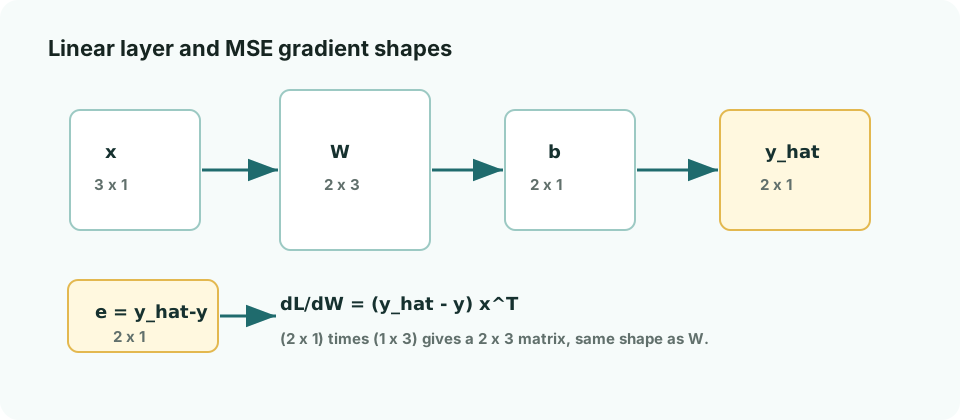
Includes matrix shapes, computation graphs, loss contours, convolution scans, and attention heatmaps.
AI Learning Project / TOOL
Deep learning math interactive visualizer
Browser modules for gradient checking, optimizer paths, convolution output size, and attention heatmaps.
AI Learning Project / CODE
cifar10_tiny_cnn.c source
Single-file C tiny CNN with CIFAR-10 loading, convolution, pooling, softmax, and backpropagation.
AI Learning Project / DATASET
model_weights.bin sample weights
Model weights generated by one local small-sample run.
AI Learning Project / DATASET
test_predictions.csv sample predictions
Sample test prediction output from the CIFAR-10 tiny CNN.
AI Learning Project / SOCIAL
Deep Learning topic share card
A 1200x630 SVG card for sharing the Deep Learning / CNN topic hub.
Site Building Project / VIDEO
SEO distribution short-video storyboards
Four 45-60 second storyboard scripts ready for later Remotion production.
FAQ
Direct answers to common search questions
Is this hub suitable without prior deep learning experience?
Yes, if you have programming basics. Start with neural network basics, then continue through matrix calculus, backpropagation, optimizers, convolution, and attention.
Why use C for the first CNN instead of only PyTorch?
The C version exposes data layout, convolution loops, and parameter updates, which makes it useful before relying on a framework.