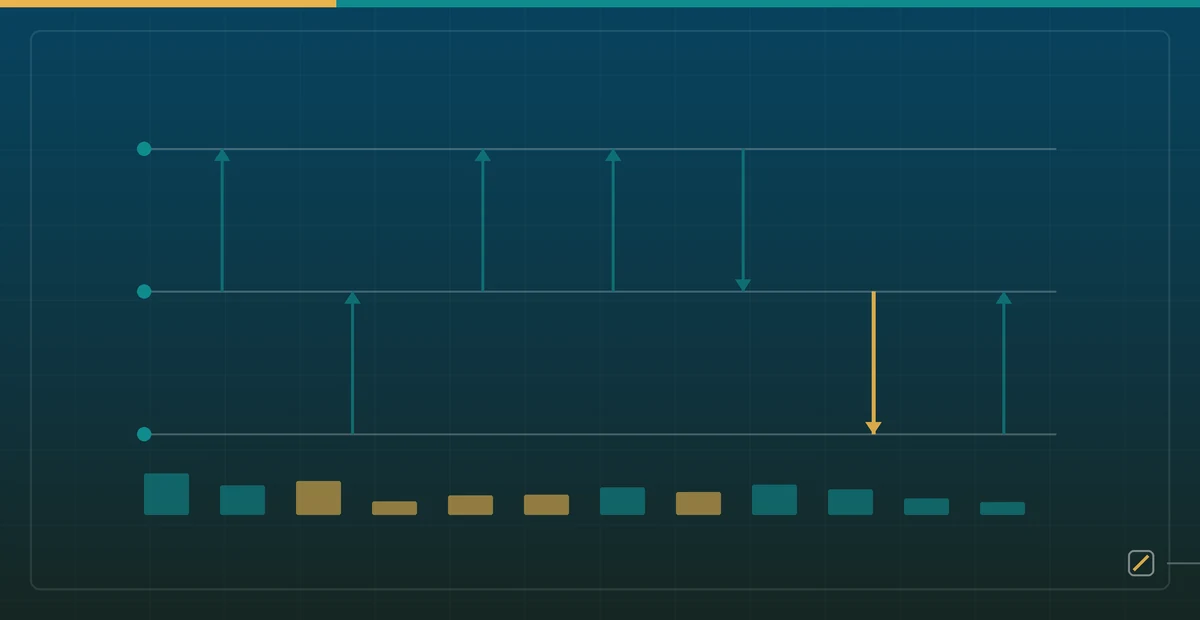

When a page loads slowly, the browser network panel shows the shape of it: requests stepping further and further right, each waiting for the one before. Every step in that waterfall corresponds to a specific wait — resolving a name, opening a connection, waiting for the first byte, queueing behind other requests.
The techniques that remove those steps act on different segments. HTTP/2 multiplexing addresses queueing; HTTP/3 over QUIC addresses one lost packet stalling an entire connection; CDN caching addresses the round-trip time imposed by physical distance. They do not substitute for one another — enable HTTP/3 while every request still reaches the origin and the waterfall stays just as long. This article follows that order: what each segment is actually waiting for, how QUIC uses connection IDs to survive a network change, what cache hit ratio is achievable (a ceiling set by the access distribution, not by cache size), and several failure modes at the cache and routing layers.
1. Protocol Streams and QUIC Kernel Mechanics
HTTP/2 represented a massive leap by multiplexing streams over a single TCP connection, but it introduced a fatal flaw: TCP-level Head-of-Line (HoL) blocking. Because TCP is a strict byte-stream protocol, if packet 4 out of 10 drops, packets 5-10 must wait in the kernel’s receive buffer until packet 4 is retransmitted. All multiplexed application streams stall.
HTTP/3 operates on QUIC (RFC 9000), a transport protocol built atop UDP. QUIC natively understands independent streams. If a packet carrying data for Stream A drops, Stream B continues processing. Furthermore, QUIC introduces Connection IDs (CIDs), allowing clients to roam across IP addresses (e.g., switching from Wi-Fi to Cellular) without breaking the connection.
At the kernel level, serving HTTP/3 efficiently requires bypassing UDP’s historically poor performance. High-performance HTTP/3 servers (like Nginx with quiche, or Cloudflare’s pingora) rely heavily on UDP_SEGMENT (UDP GSO – Generic Segmentation Offload) to process massive UDP datagrams in a single syscall.
/* Excerpt from linux/net/ipv4/udp.c handling UDP GSO */
int udp_send_skb(struct sk_buff *skb, struct flowi4 *fl4, ...)
{
    /* If GSO is enabled, pass a massive super-buffer down the stack */
    if (skb_is_gso(skb))
        udp_csum_outgoing(skb, sk);
    else
        /* standard slow path */

    return ip_send_skb(net, skb);
}
By batching QUIC packets via UDP GSO, servers reduce CPU context switching overhead by an order of magnitude, making QUIC computationally competitive with heavily optimized hardware-offloaded TCP.
Visualizing QUIC Handshakes and Cache Tiers
Below is an architectural diagram outlining a BGP Anycast CDN. The client executes a 0-RTT QUIC handshake, followed by edge caching evaluated via Consistent Hashing.
sequenceDiagram
    participant Client
    participant Edge as Anycast Edge (PoP)
    participant Origin as Origin Backend

    rect rgb(240, 248, 255)
    Note over Client, Edge: QUIC 0-RTT (Early Data) via Session Ticket
    Client->>Edge: Initial + 0-RTT CRYPTO Stream [GET /api/data]
    Edge-->>Client: Handshake Done (1-RTT Confirmed)
    end

    alt Cache HIT (Tier 1 Edge RAM)
        Edge-->>Client: 200 OK (Stream 0)
        Note over Client, Edge: Origin bypassed. RTT minimal.
    else Cache MISS (Evaluating Zipf's Law Eviction)
        Edge->>Origin: Forward via Internal Backbone (H2/H3)
        Origin-->>Edge: 200 OK
        Edge->>Edge: Write to NVMe Cache Tier
        Edge-->>Client: 200 OK (Stream 0)
    end
2. The Mathematics of Cache Hit Ratios (CHR)
CDN performance is governed mathematically by the Cache Hit Ratio (CHR). Serving 99% of traffic from the edge relies on understanding Zipf’s Law, which states that the frequency of an asset request is inversely proportional to its rank. The probability \( P \) of requesting the \( k \)-th most popular object out of \( N \) total objects is:
$$ P_k = \frac{1/k^s}{\sum_{i=1}^{N} (1/i^s)} $$
For web assets, \( s \) is typically near 1. To maximize CHR, CDNs utilize advanced eviction algorithms beyond simple LRU (Least Recently Used). Modern distributed caches employ algorithms like W-TinyLFU (Window Tiny Least Frequently Used) and Consistent Rendezvous Hashing to map requests to specific backend cache shards.
If we model the latency mathematically fixing network RTT at 36 ms, DNS hit at 1 ms, and cache lookup at 4 ms:
H2 MISS = DNS 42 + TCP+TLS Connect 72 (2 RTT) + Origin Path 62 = 176 ms
H3 MISS = DNS 42 + QUIC Connect 36 (1 RTT) + Origin Path 62 = 140 ms
H3 0-RTT HIT = DNS 1 + Connect 0 (Early Data) + Edge Lookup 4 = 5 ms
Moving from a cold HTTP/2 MISS to a warm HTTP/3 0-RTT HIT mathematically obliterates 171ms of dead waiting time.
3. Deep Debugging: qlog and `stale-while-revalidate`
To debug QUIC internals, relying on traditional tcpdump is insufficient because QUIC completely encrypts the transport headers (including packet numbers). Engineers must use qlog, a standard JSON-based logging format output by QUIC libraries, enabling deep analysis of HoL blocking events and stream flow control.
# Enable qlog on a supported server (e.g., quiche)
export QLOGDIR=/var/log/quic/
# Load the resulting .qlog file into qvis (QUIC Visualizer)
On the caching side, the most dangerous race condition is the Cache Stampede (Thundering Herd). When a highly requested JSON payload expires, thousands of concurrent requests miss the cache and hammer the origin server simultaneously. This is mitigated using stale-while-revalidate in the Cache-Control header:
# The CDN will serve stale data to users while asynchronously fetching an update
Cache-Control: max-age=60, stale-while-revalidate=86400

# Verify Cache Status headers via cURL
curl -I --http3 https://example.com/api/data
# HTTP/3 200
# cf-cache-status: STALE
# alt-svc: h3=":443"; ma=86400
4. Production Architecture Post-Mortem
BGP Anycast and UDP Path Asymmetry
When migrating a massive mobile application API to HTTP/3, we encountered an agonizing issue: QUIC connections were randomly stalling. The root cause lay in our BGP Anycast routing architecture interacting with UDP path asymmetry.
In BGP Anycast, multiple edge locations broadcast the same IP address. Mobile networks frequently change internal IP paths. With TCP, asymmetric routing is usually fine because stateful firewalls track the connection. With UDP (QUIC), the carrier-grade NAT (CGNAT) gateways and stateful edge load-balancers failed to map the returning UDP packets back to the original connection state. Furthermore, a BGP flap would route the client’s UDP packets to a different physical PoP (Point of Presence).
To resolve this, we had to implement stateless QUIC connection ID routing at our edge load balancers (Layer 4). Instead of hashing on the 5-tuple (Source IP/Port), our eBPF XDP programs extracted the QUIC Connection ID from the UDP payload and routed the packet consistently to the same backend server, regardless of how many times the client’s IP changed or which PoP received the traffic.
5. Automated Modeling Script
We use Python to deterministically simulate the latency reductions and calculate the Zipf distribution impact on the CDN tier.
python src/http_cdn_waterfall.py
# Simulates QUIC handshake combinations against CDN cache tiers
# Simplified cache stampede modeling
total_h2_miss = 42 + (36 * 2) + 36 + 26
total_h3_0rtt = 1 + 0 + 4 # 0-RTT Early Data Hit
modeled_saving = total_h2_miss - total_h3_0rtt

print(f"Total time saved migrating from H2 MISS to H3 0-RTT: {modeled_saving}ms")
Full datasets of these architectural simulations are stored in http-cdn-waterfall-results.csv.
6. Animated Walkthrough
7. Engineering Heuristics & Anti-Patterns
- Vary Header Misconfigurations: Setting
Vary: User-Agentdestroys your Cache Hit Ratio. The CDN will cache a different copy for every minor browser version string. UseVary: Accept-Encodinginstead. - Ignoring UDP Rate Limits: Many enterprise firewalls treat UDP 443 traffic as suspicious peer-to-peer or DDoS traffic, throttling it. You must ensure seamless fallback to HTTP/2 via the
Alt-Svcheader. - CPU Saturation on QUIC: Migrating to HTTP/3 requires 2x-3x more CPU at the load balancer compared to TCP, due to the user-space cryptography and lack of mature hardware offloads. Provision your proxy fleet accordingly.
8. HTTP/3 and CDN Evidence Matrix
A page is not faster simply because the protocol name changed. HTTP/3, 0-RTT, CDN HIT, stale-while-revalidate, and browser rendering affect different phases of the waterfall. The matrix below ties each phase to headers, qlog traces, cache state, and frontend metrics so readers can identify whether the improvement came from transport, caching, or rendering.
| Symptom | Key evidence | Likely cause | How to verify |
|---|---|---|---|
| TTFB drops sharply | cf-cache-status, Age, Cache-Control, and edge location. |
CDN HIT or stale response served from the edge. | Compare headers and timing across MISS, HIT, and STALE requests. |
| HTTP/3 first request is faster | alt-svc, QUIC handshake, qlog trace, and 0-RTT state. |
TCP+TLS round trips were removed or early data was reused. | Compare cold connection, session resumption, and HTTP/3-disabled runs. |
| Mobile QUIC connections stall intermittently | Connection ID, UDP NAT mapping, PoP changes, and reconnect logs. | Anycast path changes or L4 load balancing is not sticky by CID. | Check whether the same CID is routed to different backends. |
| TTFB is fast but LCP is slow | Core Web Vitals, blocking JS/CSS, image size, and long main-thread tasks. | Caching fixed network wait but not frontend rendering cost. | Use Lighthouse or the Performance panel to separate network time from render time. |
FAQ
Why did HTTP/3 abandon TCP entirely?
You cannot fix TCP-level HoL blocking without fundamentally altering the TCP packet header format and state machine. Such changes would take decades to deploy because thousands of middleboxes (NATs, firewalls, ISPs) hardcode their understanding of the existing TCP header. Building QUIC over UDP encrypts the transport state, completely hiding it from interfering middleboxes.
Does a CDN HIT guarantee a fast Largest Contentful Paint (LCP)?
No. A Cache Hit guarantees a fast Time to First Byte (TTFB). If the browser receives the HTML instantly but must then parse 4MB of blocking JavaScript before rendering the DOM, your LCP will still be abysmal.
References
By mastering routing, TCP reliability, and finally HTTP/3 caching, you now possess the complete end-to-end framework necessary to architect ultra-low-latency global networks.