
Battery Modeling for AI
This topic connects battery simulation, impedance features, aging labels, and machine learning workflows. The point is not to treat a cell model as a black-box data generator. A useful battery AI workflow needs to explain where labels come from, which operating conditions were simulated, how parameters were varied, and why a model trained on one split should or should not generalize to another cell, cycle range, or temperature range.
The route starts with PyBaMM architecture and parameter values, then moves into EIS data generation, aging simulation, feature tables, and supervised learning for SOH or RUL-style targets. Readers should be able to inspect both the physical assumptions and the machine learning assumptions before trusting any prediction.
How to Read This Route
Begin with the modeling articles if you are new to electrochemical simulation. Understand what a model, parameter set, experiment, and solver are doing before you export features. Then read the EIS and aging dataset articles as data pipeline examples: frequency sweeps, SOC windows, metadata, label definitions, and train/test isolation matter as much as the downstream regressor.
The articles form two tracks. The data pipeline track goes from PyBaMM’s architecture through EIS labels and the aging dataset to SOH/RUL training. The silent-failures track works through parameter sets, experiments, thermal models, capacity definitions, SEI and lithium plating, solver convergence and parameter fitting: most of these problems raise no error and return a normal-looking but wrong result, while the solver article covers runs that do crash and how to tell a numerical cause from a physical one. The series bar before each article’s first section shows its track and position.
If you come from machine learning, pay attention to leakage. Splitting rows at random can make a battery dataset look better than it is if cycles, cells, or parameter regimes appear in both train and test data. If you come from battery modeling, pay attention to feature reproducibility, dependency versions, and the gap between simulated labels and measured field data.
Reproducibility and Limits
- Record PyBaMM, Python, NumPy, pandas, and scikit-learn versions before comparing results.
- Keep simulation data, public datasets, and real device data separate in your notes.
- Check whether the validation split is isolated by cell, cycle, time, or operating condition.
- Do not use educational model outputs as production BMS decisions without domain review.
What Counts as a Useful Dataset
A useful battery AI dataset is more than a table with many rows. It should describe the simulated or measured operating conditions, the model or device source, the parameter variations, the frequency range for impedance data, the cycle or time index, and the exact label definition. Without those details, a model can look accurate while learning shortcuts that would not survive a different cell, temperature, duty cycle, or validation split.
For educational simulation data, the page should also preserve the reason the dataset was generated. Was it built to test feature extraction, compare split strategies, train a regressor, or explain a physical trend? The answer changes how the dataset should be used and which limitations need to be visible to readers.
Validation Questions
Before trusting a battery prediction workflow, ask whether the validation split separates the factor you care about. A row-level random split may test interpolation inside the same simulated regime, while a cell-level, parameter-level, cycle-level, or temperature-level split tests a harder question. The page should make that distinction explicit whenever SOH, RUL, impedance features, or aging labels are discussed.
The route also separates scientific interpretation from engineering deployment. A supervised model can help explore which features correlate with simulated aging labels, but a production BMS decision requires sensor validation, safety review, domain calibration, monitoring, and independent testing. That boundary is part of the content, not an afterthought.
Dataset Audit Table
| Audit item | Why it matters | What the page should state |
|---|---|---|
| Operating conditions | A model may only learn a narrow SOC, temperature, or rate window. | SOC window, temperature, rate, cycle range, and impedance frequency range. |
| Label source | SOH/RUL evaluation is not interpretable when labels are vague. | Label formula, threshold, time index, and simulated or measured source. |
| Split strategy | A row-level split can leak the same cell or parameter regime into testing. | Whether rows, cells, cycles, temperatures, or parameter regimes are isolated. |
| Deployment boundary | Educational simulation does not automatically represent production BMS use. | Sensor error, domain shift, safety review, and independent validation needs. |
Topic hub
Battery Modeling for AI Data
A PyBaMM route from model architecture and EIS spectra to a traceable labeled battery-aging data factory for AI training.
For PhD students and research engineers searching for PyBaMM, Oxford battery modeling, EISSimulation, SOH/RUL labels, LLI/LAM, and battery AI data generation.
Editorial notes
Why these articles belong in one route
The battery modeling hub emphasizes traceable data instead of treating simulation curves as real experimental conclusions. The articles separate model parameters, protocols, impedance spectra, aging state, and AI labels.
The PyBaMM route starts with the modeling pipeline and EISSimulation, then moves to aging data generation, SOH/RUL labels, and regression training. Each step keeps manifests or quality reports for leakage and generalization review.
What you will build
You will read PyBaMM as a modeling pipeline, run impedance and aging examples, and train SOH/RUL regressors.
Recommended reading order
Start with concepts, then move into runnable projects
Reading PyBaMM Fast: Architecture for Battery Modeling and AI Data
A PhD-level guide to PyBaMM expression trees, Simulation, model options, metadata, and AI dataset design.
PyBaMM’s Built-in Parameter Sets, Measured: Four Ways They Fail Silently
The same experiments run on all 18 built-in parameter sets in PyBaMM 26.5. The sets that error are not the problem; the ones that finish and are wrong are. "1C" on the default set is really 0.78C, Chen2020 loses 0.6% of its capacity at −10°C, an experiment string charges an LFP cell to 4.2 V with zero warnings, and SEI runs on borrowed example parameters. Includes a check you can run.
PyBaMM Experiments That Finish and Are Wrong: Five Traps, Measured
PyBaMM's Experiment API almost never raises, and each of these five mistakes returns a normal-looking solution: steps in amps stop silently at 24 hours, a flat step list overstates cycle life fourfold, save_at_cycles leaves None in the list, period never changes PyBaMM's answers but can break yours, and initial_soc=1 is not 4.2 V. Includes a completion check.
PyBaMM Thermal Models, Measured: Zero Heating, Missing Entropy and a Cold Start at 25 °C
PyBaMM's thermal options run without complaint, and each of these set-ups returns a plausible temperature curve: isothermal heating variables are zero by construction, four parameter sets have no reversible heat, four describe a single electrode sheet cooled on both faces, and a cold-start run that sets only the ambient temperature begins at 25 °C. Measured on eight parameter sets, with an audit function.
What PyBaMM’s Capacity Numbers Measure: “80% capacity”, Capacity [A.h] and Loss of Capacity to SEI
PyBaMM has several different things called capacity, and degradation studies quietly mix them: termination="80% capacity" compares a zero-current eSOH capacity, not a measured discharge; summary variables are read at the end of each cycle; 'Loss of capacity to X' is lithium, not capacity; and the default parameter set gains capacity as it loses lithium. Measured in PyBaMM 26.5, with an audit function.
PyBaMM SEI and Lithium Plating Pitfalls: Clock-Driven SEI, Placeholder Rates, Temperature and Pore Clogging
The choices that decide a PyBaMM fade curve never raise an error: OKane2022's SEI grows with time alone, so rests change cycle count but not the end-of-life date; the SEI rate constants are generic placeholders that differ 450-fold between options; activation energy is zero in every other set; a cold plating clog is overstated 5-fold on the default mesh; and 'irreversible' plating deposits lithium at rest. Measured in PyBaMM 26.5, with a pre-flight check.
PyBaMM EIS Data Generation: Impedance Features and AI Labels
Use PyBaMM core EISSimulation to generate impedance spectra, extract features, and align them with aging labels.
Generate Battery Aging and EIS AI Datasets with PyBaMM
Build a reproducible PyBaMM data factory for SOH, RUL, LLI, LAM, plating, and impedance-feature labels.
Training a Battery AI Model with PyBaMM: Predicting SOH and RUL
Train scikit-learn regressors on PyBaMM-style EIS features and operating metadata to predict battery SOH and RUL.
PyBaMM Solver Convergence Failures: Numerics or Physics
When a long degradation run dies at cycle 300, reaching for tolerances is usually wrong. Tell numerics from physics with an SPMe cross-check, plus every IDAKLU option default and one trap that fails silently.
Fitting PyBaMM Parameters: Why the Optimiser’s Numbers May Mean Nothing
The top search result, pybamm-param, is deprecated; PyBOP just restructured its API; and identifiability means an optimiser handed fifty free parameters returns fifty meaningless numbers. Includes a protocol separating a fit from a decoration.
Resources and distribution assets
Code, data, diagrams, and share assets in one place
Battery Modeling for AI / GUIDE
PyBaMM AI Data Lab README
Setup, quick run, backend behavior, and output schemas for the PyBaMM battery AI data pipeline.
Battery Modeling for AI / ARCHIVE
PyBaMM AI Data Lab full bundle
Bundles design generation, aging sweeps, EIS sweeps, label building, validation checks, sample CSVs, and figures.
Battery Modeling for AI / DATASET
PyBaMM sample manifest
Stores sample id, model family, parameter set, protocol, temperature, SOC, cycle, split group, and label source.
Battery Modeling for AI / DATASET
PyBaMM EIS sample spectra CSV
Frequency-level impedance output with frequency, Z_re, Z_im, magnitude, phase, backend, and solver status.
Battery Modeling for AI / DATASET
Battery aging and EIS labels CSV
Stores SOH, RUL proxy, LLI, LAM, plating, local resistance, and EIS features.
Battery Modeling for AI / DATASET
PyBaMM AI data quality report
Records duplicate samples, duplicate spectrum points, missing labels, split leakage, and backend usage.
Battery Modeling for AI / DATASET
SOH/RUL training metrics CSV
Stores group split, MAE, RMSE, R2, label source, and backend used for auditing model results.
Battery Modeling for AI / DATASET
SOH/RUL held-out predictions CSV
Stores held-out true values, predictions, and absolute errors.
Battery Modeling for AI / DATASET
SOH/RUL feature importance CSV
Records random-forest feature importance values for each target model.
Battery Modeling for AI / DIAGRAM
PyBaMM to AI data pipeline figure
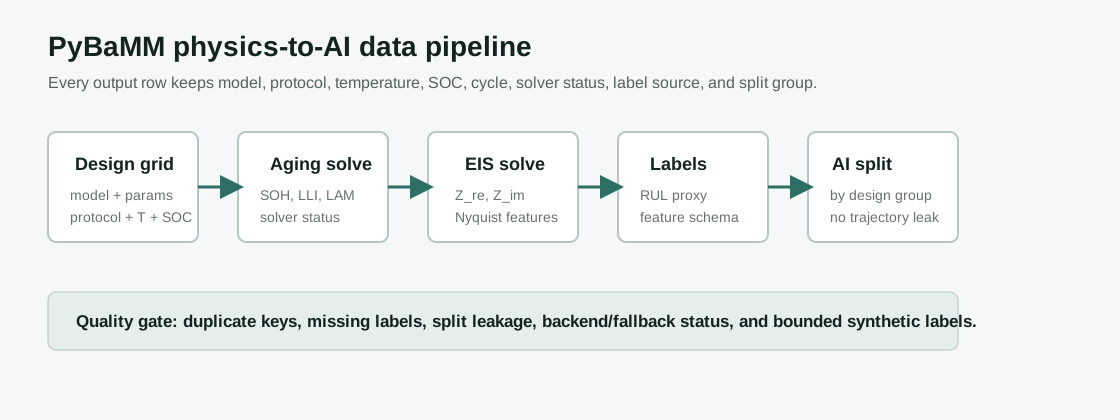
Shows design grid, aging solve, EIS solve, label build, quality gate, and AI split.
Battery Modeling for AI / DIAGRAM
EIS feature and label schema figure
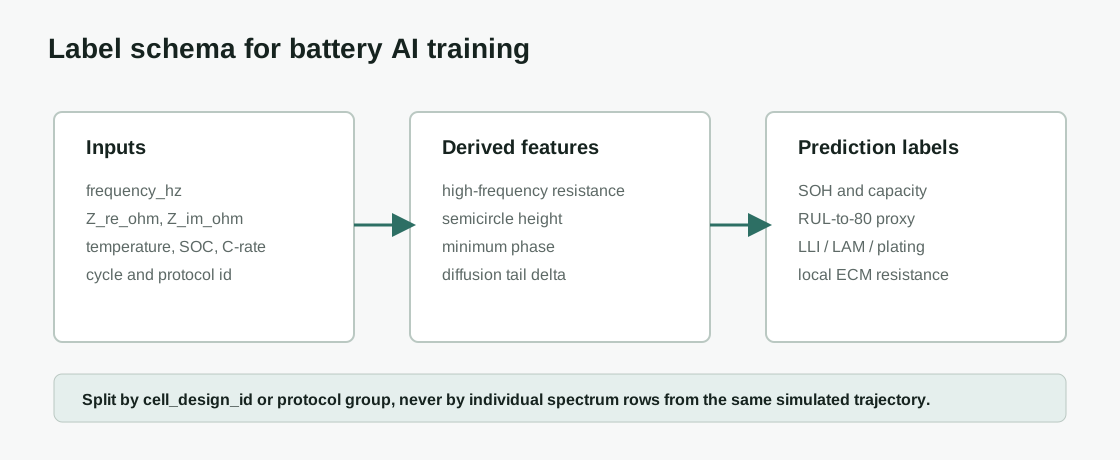
Connects frequency points, impedance features, operating metadata, and SOH/RUL/degradation labels.
Battery Modeling for AI / DIAGRAM
Aging label sample figure
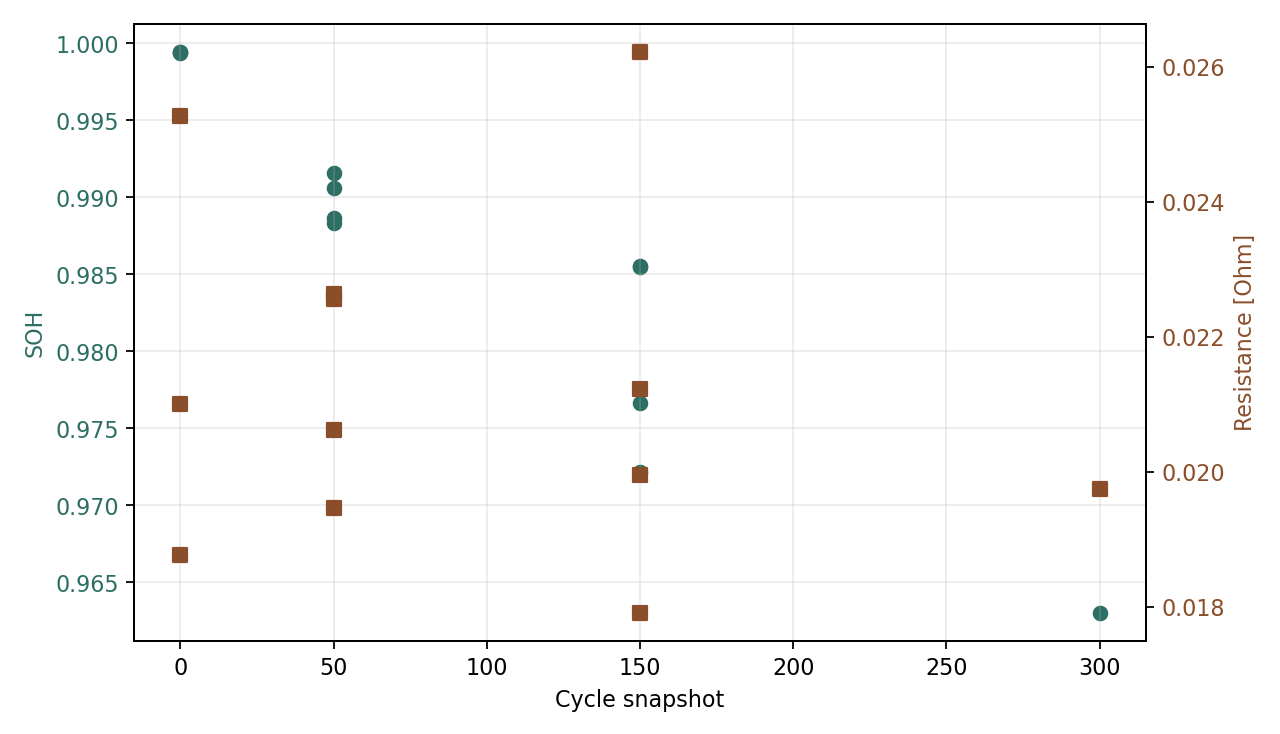
Sample figure showing cycle snapshots, SOH, and local ECM resistance labels.
Battery Modeling for AI / DIAGRAM
SOH/RUL training results figure
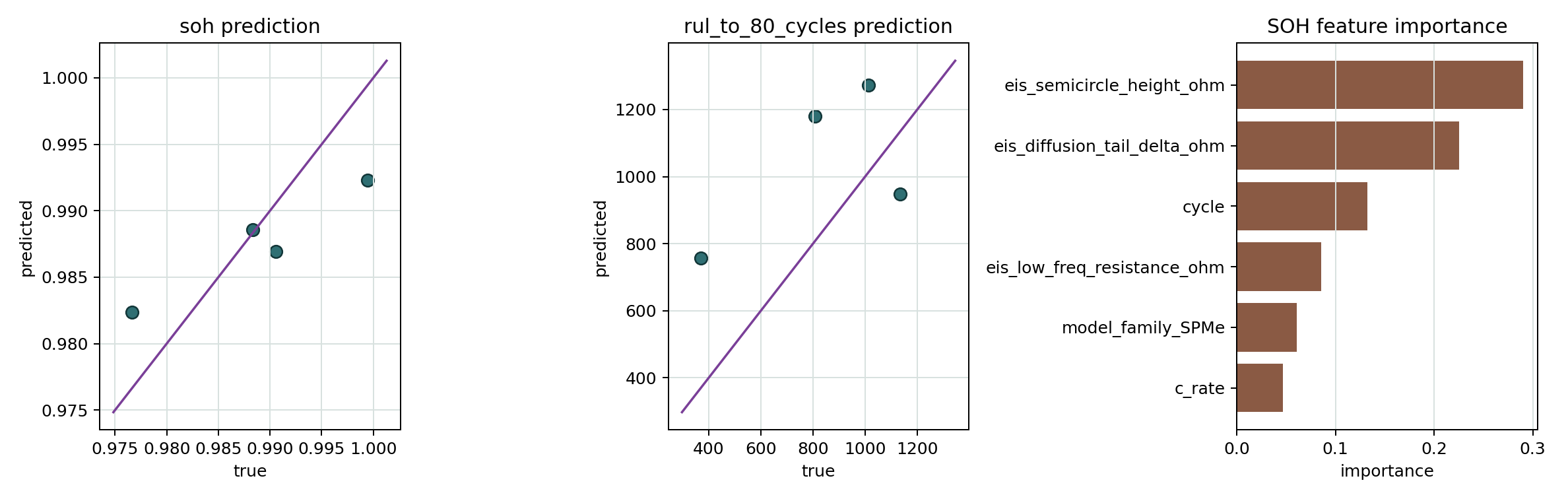
Shows held-out SOH/RUL prediction scatter plots and SOH feature importance.
Battery Modeling for AI / SOCIAL
Battery Modeling for AI share card
OG share card for the PyBaMM battery modeling, EIS, aging simulation, and AI data hub.
FAQ
Direct answers to common search questions
Can these data replace real battery experiments?
No. They are physics-based synthetic data for pretraining, pipeline validation, and experiment design; real claims still need calibration and out-of-domain validation.
Why not use the old pybamm-eis package?
The old repository is archived. The articles and lab use pybamm.EISSimulation from PyBaMM core.
Why split by cell_design_id or protocol_id?
Frequency points and cycle snapshots from the same simulated trajectory are highly correlated; row-level random splits leak information.