
A web page loads reliably not because the Internet backbone provides lossless transit, but because the TCP state machine strictly enforces sequence continuity through precisely specified congestion control. For High-Frequency Trading (HFT) platforms or massive Content Delivery Networks (CDNs), the standard TCP textbook explanation is inadequate. In these environments, you must tune the Linux kernel’s congestion window (cwnd) and receive window (rwnd) to combat bufferbloat, minimize 99th-percentile tail latency, and optimize pacing algorithms on Long Fat Networks (LFN).
This article traces the exact lifecycle of TCP segments within the Linux net/ipv4/tcp_input.c source code, analyze the differential equations behind CUBIC and BBR congestion control, and utilize `perf` and flame graphs to debug performance limits at scale.
1. Sequence Space and Kernel State Machines
The 3-way handshake (SYN, SYN-ACK, ACK) is rarely the performance bottleneck unless you suffer from SYN flood attacks (mitigated by net.ipv4.tcp_syncookies). The true complexity of TCP lies in managing the Sequence Space during data transfer.
In the Linux kernel, every TCP connection is represented by a struct tcp_sock. When an ACK is received, the kernel invokes tcp_ack(). This massive function must determine if the ACK is a duplicate, if it contains Selective Acknowledgments (SACK), and whether it should update the cwnd.
/* Excerpt from linux/net/ipv4/tcp_input.c */
static int tcp_ack(struct sock *sk, const struct sk_buff *skb, int flag)
{
    struct tcp_sock *tp = tcp_sk(sk);
    u32 prior_snd_una = tp->snd_una;
    u32 ack_seq = TCP_SKB_CB(skb)->ack_seq;

    /* If the ACK is out of bounds, drop it */
    if (before(ack_seq, prior_snd_una))
        goto old_ack;

    /* Process SACK blocks to detect out-of-order delivery */
    if (tcp_is_sack(tp) && tcp_check_sack_reneging(sk, flag))
        tcp_retransmit_timer(sk);

    /* Update the congestion control state machine */
    tcp_cong_control(sk, ack_seq, prior_snd_una, flag);
    return 1;
}
If sequence numbers jump out of order, the kernel buffers the out-of-order packets in the Out-Of-Order (OOO) queue and returns a Duplicate ACK. Three Duplicate ACKs bypass the Retransmission Timeout (RTO) timer and trigger Fast Retransmit.
sequenceDiagram
    participant Client (tcp_output)
    participant Server (tcp_input)
    Note over Client,Server: RTT = 20ms, MSS = 1460
    Client->>Server: DATA, seq=1001, len=1460
    Server->>Client: ACK, ack=2461
    Client-xServer: DATA, seq=2461, len=1460 (Loss!)
    Client->>Server: DATA, seq=3921, len=1460
    Server->>Client: DUP ACK, ack=2461 (SACK 3921-5381)
    Client->>Server: DATA, seq=5381, len=1460
    Server->>Client: DUP ACK, ack=2461 (SACK 3921-6841)
    Note over Client: Fast Retransmit Triggered (3 DUP ACKs)
    Client->>Server: DATA, seq=2461, len=1460 (Retransmission)
    Server->>Client: ACK, ack=6841 (Cumulative ACK advances!)
2. The Mathematics of Congestion Control
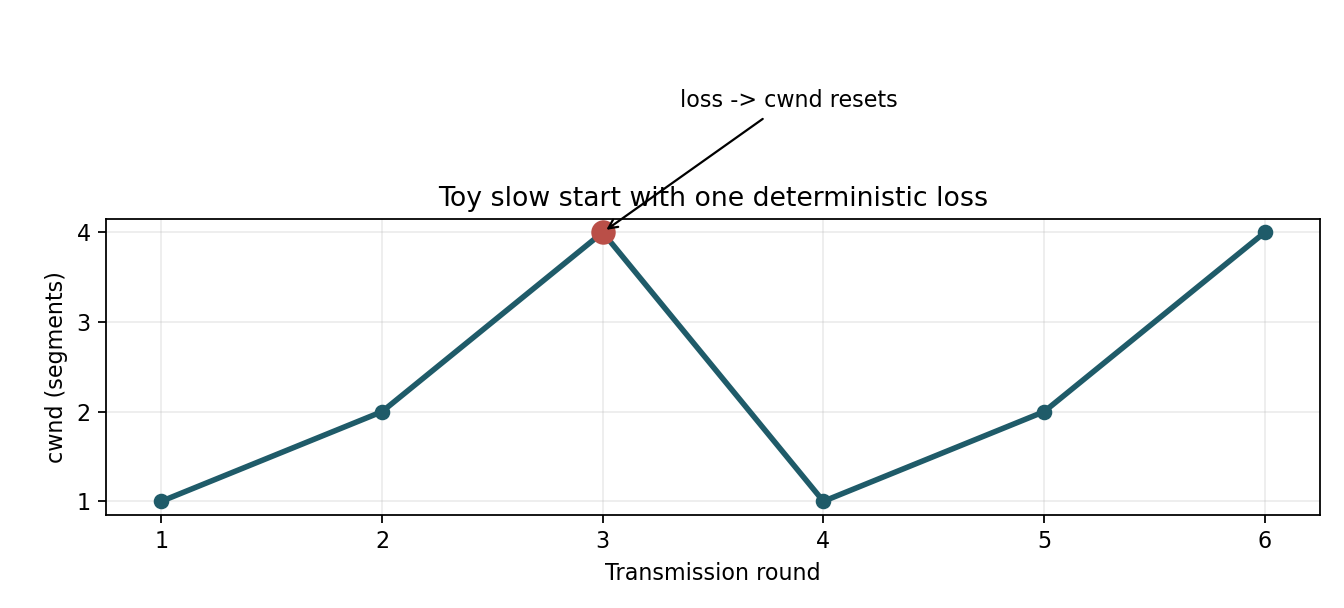
When packet loss occurs, TCP reacts by modulating its sending window. Standard algorithms like NewReno use an Additive Increase, Multiplicative Decrease (AIMD) mathematical model.
The CUBIC Algorithm
The default in older Linux kernels is CUBIC. CUBIC governs window growth via a cubic function of time since the last congestion event, making it independent of RTT. The window \( W \) at time \( t \) is defined as:
$$ W_{cubic}(t) = C(t-K)^3 + W_{max} $$
Where \( K = \sqrt[3]{ \frac{W_{max} \beta}{C} } \) and \( \beta \) is the multiplicative decrease factor (usually 0.7 for CUBIC). When a loss event happens, CUBIC aggressively slashes the window \( W = W \times \beta \).
The BBR Algorithm (Bottleneck Bandwidth and RTT)
Unlike CUBIC, BBR does not view packet loss as congestion. BBR measures the exact Delivery Rate and Minimum RTT using Little’s Law (\( L = \lambda W \)). It computes the optimal In-Flight data (Bandwidth-Delay Product, BDP):
$$ BDP = BtlBw \times RTprop $$
BBR phases through PROBE_BW and PROBE_RTT. To probe bandwidth, it applies a Pacing Gain of \( 1.25 \) (sending 25% faster than the measured bottleneck). When queues build up and latency rises, BBR drops the pacing gain to \( 0.75 \) to drain the bottleneck buffer, completely immunizing the connection against non-congestion random packet loss.
3. Kernel Instrumentation: `perf` and Flame Graphs
In high-throughput environments, you must profile the TCP stack CPU overhead. Flame graphs generated via perf often reveal bottlenecks in checksum calculations or lock contention.
# Profile TCP retransmissions across the entire kernel
sudo perf record -e tcp:tcp_retransmit_skb -aR -g
sudo perf script | stackcollapse-perf.pl | flamegraph.pl > tcp_retrans_flame.svg

# Monitor active connections using ss (socket statistics)
# Extract precise BBR bandwidth estimates and RTT
ss -nti | grep -A 1 'ESTAB'
# Example Output:
#  cwnd:10 pacing_rate 1200Mbps delivery_rate 950Mbps bbr:(bw:950Mbps,mrtt:15.2ms,pacing_gain:1.25)
By capturing tcp:tcp_retransmit_skb, engineers can correlate retransmission spikes directly with application layer latencies or GC (Garbage Collection) pauses.
4. Production Architecture Post-Mortem
Bufferbloat and the FQ-CoDel Intervention
During the launch of a live-streaming platform, we encountered massive stuttering on client video players. Our load balancers were capable of pushing 40Gbps, but user latency would inexplicably spike from 30ms to 2500ms. Analyzing the
ss -ntioutput revealed that our TCP cwnd was enormous, but the RTT was catastrophic.This was a classic case of Bufferbloat. The intermediate routers had massive buffers. CUBIC kept increasing its window, filling these buffers until they overflowed. Instead of dropping packets early to signal congestion, the routers held them, introducing astronomical queueing delay.
We resolved this by migrating the kernel Queuing Discipline (Qdisc) to
fq_codel(Fair Queueing Controlled Delay) and switching the congestion algorithm to BBR. FQ-CoDel actively drops packets from fat flows if they sit in the queue too long, and BBR paced the TCP packets exactly to the bottleneck bandwidth. Tail latency immediately stabilized under 50ms.
sysctl -w net.core.default_qdisc=fq_codel
sysctl -w net.ipv4.tcp_congestion_control=bbr
5. Automated Event Simulation
For mathematical verification without relying on volatile internet links, we use a Python script running alongside a C11 socket program bound to 127.0.0.1 to export precise event matrices for AIMD and BBR simulations.
python src/tcp_reliability_cwnd.py
cc -std=c11 -Wall -Wextra -O2 src/tcp_loopback_echo.c -o /tmp/tcp_echo
/tmp/tcp_echo
Simulation outputs, including phase shifts and BDP estimates, are exported to tcp-cwnd-results.csv.
6. Animated Walkthrough
7. Engineering Heuristics & Anti-Patterns
- Disabling Hardware Offloading: Never manually disable TSO (TCP Segmentation Offload) or LRO (Large Receive Offload) unless debugging a buggy NIC driver. Offloading saves up to 40% of CPU cycles by avoiding per-packet TCP header processing in the kernel.
- Misinterpreting 0-Window: A
TCP Zero Windowpacket from the client means the client’s application is not reading data from its socket buffer fast enough (application bottleneck), NOT that the network is congested. - Over-tuning Sysctls: Randomly increasing
tcp_rmemandtcp_wmemto gigabytes does not increase speed; it only exacerbates bufferbloat and consumes kernel memory. Stick to autotuning defaults unless you are on a massive Long Fat Network (e.g., transatlantic 100Gbps links).
8. TCP Troubleshooting Evidence Matrix
TCP failures cannot be judged from packet loss alone. Reliability, receive windows, congestion control, queue behavior, and application read speed all influence the final symptom. The matrix below maps symptoms to evidence so a reader can separate network congestion from application stalls, bufferbloat, and poor congestion-control settings.
| Symptom | Key evidence | Inspect first | Do not mistake it for |
|---|---|---|---|
| Sawtooth throughput drops | cwnd, retransmits, and congestion algorithm from ss -nti. |
CUBIC multiplicative decrease, random loss, or queue drops. | Application-level rate limiting. |
| P99 latency suddenly spikes | RTT distribution, queue delay, and tcp_retransmit_skb events. |
Bufferbloat, upstream queuing, or wireless jitter. | Database slow queries. |
| Frequent Zero Window packets | Receive window, application recv() rate, CPU, and GC state. |
The receiving application is not draining its socket buffer. | Middlebox congestion. |
| BBR behaves inconsistently | Pacing rate, delivery rate, min RTT, and qdisc configuration. | Missing pacing, wrong queue discipline, or polluted bandwidth estimate. | BBR being universally ineffective. |
FAQ
Why did BBR completely replace CUBIC at Google?
Loss-based algorithms like CUBIC assume packet loss only happens because of congestion. On modern wireless networks (Wi-Fi, 5G), loss often happens due to radio interference. CUBIC halves its throughput for a random signal drop. BBR recognizes that the RTT didn’t spike, ignores the random loss, and maintains maximum throughput.
Does the 3-Way Handshake guarantee delivery?
Absolutely not. It merely establishes cryptographic sequence initialization and negotiates extensions (SACK, WScale). Actual data delivery is strictly governed by the sliding window and timeout retransmissions.
References
- Linux Kernel IP Sysctl Documentation
- BBR: Congestion-Based Congestion Control
- RFC 8229: TCP Encapsulation
With reliability mathematically guaranteed by TCP, our final frontier is the application layer. The next article explores the protocol that runs atop TCP/QUIC: HTTP/3 and edge CDN caching.
Related: loopback cannot drop packets, but it retransmitted 62 times — a real investigation that used retransmit counters and the TCP state distribution as its entry point.